The obligation is already yours
AI literacy has been a legal duty for every organization deploying AI in the EU market since February 2, 2025. That is EU AI Act Article 4, and it applied nearly three years before the first of the high-risk rules and with no exemption for company size.
The text is short. As amended by the Digital Omnibus on AI (Regulation (EU) 2026/1744, in force July 27, 2026), providers and deployers must take measures to support the development of AI literacy among their staff and others operating AI systems on their behalf, taking into account their technical knowledge, experience, education and training and the context the AI systems are to be used in, and considering the persons or groups of persons on whom the AI systems are to be used.
Read that carefully, because three words in it decide what satisfies the obligation and what does not. Measures. Their. Context. The duty is not to deliver training, and it is not to guarantee a test score. It is to take measures that fit what each person does with AI, and to be able to show which measures were taken, for whom and when.
Article 4 is also the first control in any governance program, not an HR afterthought. Every other control assumes that the people holding it can tell when they are using AI, know what the boundary is, can check what it tells them, know when to escalate and know who is accountable. A policy nobody can read is not a control. A human in the loop who cannot tell when to disagree is not oversight. Literacy is the precondition for everything that follows, and the law put it first for that reason.
What literacy actually is
AI literacy is five capacities. Every seat in the organization needs all five. Only the depth differs.
| Capacity | The question it answers | Why it is hard |
|---|---|---|
| Recognition | Can you tell you are using AI at all? | AI now arrives embedded inside ordinary software, without an announcement |
| Boundary | Do you know what this AI may and may not do in your hands? | The list exists in pieces, and rarely on one page |
| Verification | Can you check what it told you before you act on it? | Confident, fluent output is the hardest kind to doubt |
| Escalation | Do you know when something has moved outside the boundary, and who to tell? | Most people have never been told who that is |
| Accountability | Do you know who signs for this system, and that the signature is a person? | Shared ownership is nobody's ownership |
Recognition is the hardest of the five and the one most programs skip. The person who opens a chatbot knows they are using AI. The person whose CRM now drafts the email, whose spreadsheet now suggests the formula, whose helpdesk now triages the ticket, often does not. Embedded AI in ordinary SaaS makes near-universal exposure the safe assumption, which is why the floor applies to everyone.
Depth comes in three bands. Awareness is enough to recognize, stay inside the boundary and escalate. Working depth adds the ability to verify output and apply the policy in daily work. Deep is for the people who set the boundary, sign for the system or answer to a regulator. A receptionist and a CISO both need all five capacities. They do not need them at the same depth, and that difference is the entire reason one org-wide module cannot satisfy Article 4.
Who is responsible for what
The obligation lands on the organization. Inside it, each role owes a specific part, and each needs literacy at a specific depth.
| Role | What you owe | Depth | What an auditor will ask you |
|---|---|---|---|
| Board | Oversight that a literacy program exists and is reported on | Awareness, plus Deep on accountability | When were you last briefed, and what did you do with it? |
| CEO | That the program has an accountable owner and a budget line | Working | Who owns this, and when did you sign for it? |
| CISO or CTO | The boundary list: what the agents may not do, who signs when it changes, and who is trained to hold it | Deep | Show me the one-page list and the name against it |
| General Counsel | That the training maps to the articles that apply, and that the record will stand | Deep on boundary and accountability | Which instrument, which article, which date? |
| HR or People | The register of who holds which seat and when they were last assessed | Working | Who touches AI, and how do you know? |
| Every employee | Literacy at the depth of their seat, kept current | Awareness floor, Working where the role demands it | Did you know you were using it, and what would you have done if it went wrong? |
The HR row deserves a word. Role-based training assumes someone can map people to roles, and the usual objection is that the HR system holds job titles and nothing recording who touches an AI tool day to day. That objection is correct and it points at the wrong source. The axis is exposure, not title. With AI embedded across ordinary software, the safe assumption is that everyone is exposed, so the awareness floor applies to all, and the deeper tracks attach to accountable seats by a business decision rather than an org chart lookup.
Why the usual methods fall short of the obligation
Most organizations have already done something. The something is usually one of a few things, and each is useful for what it is. None of them is what Article 4 asks for, and it helps to be precise about why.
| What was done | What it actually establishes | Where it falls short of Article 4 |
|---|---|---|
| A video or webinar everyone watched | Attendance. Someone pressed play | Not role-based, not scored, not evidence of capacity. It is the same depth for the receptionist and the CISO |
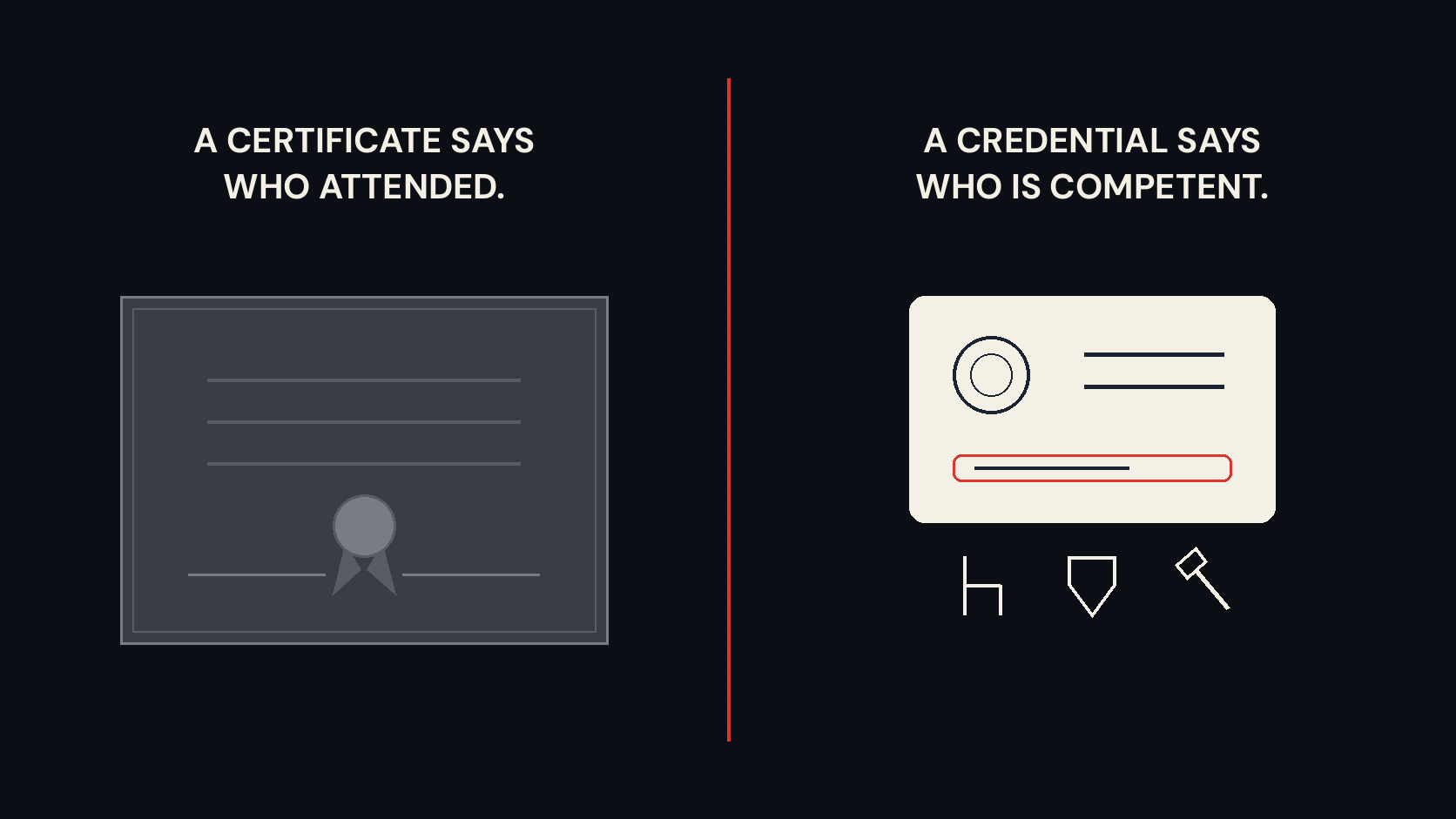
| A certificate of completion | That a person finished a course on a date | It says who attended. It cannot tell you who is competent, and it rarely names the role it was earned for |
| A PDF policy or handbook in a shared drive | That a document exists | Reading is not literacy. Nothing records that it was understood, and nothing is dated per person |
| A policy acknowledgment click | Notification. The person was told | Acknowledgment is a legal formality, not a capacity. It proves the policy was sent, not that the boundary is held |
| Tool proficiency training | Operation. How to use the product | Knowing the buttons is not knowing the boundary, the verification habit or the escalation path |
| An academic or ethics course | Subject knowledge | Valuable, and not tied to what this person does with this AI in this organization |
The common thread is that each produces a record of an event, not evidence of a capacity. Literacy you cannot evidence is, to a regulator or an underwriter, indistinguishable from no literacy at all. And whatever record exists expires, because the tools change, the seat changes and the law changes, and the certificate from March says nothing about September.
What satisfies it
Three properties, and a program needs all three.
Role-tailored. The content and the depth match the seat. A board member is assessed on oversight and accountability. An employee is assessed on recognition, boundary and escalation. A CISO is assessed on all five at depth. The same ten questions for everyone is a notification exercise with a quiz attached.
Scored the same way every time. The assessment is the same instrument, graded the same way, for every person in the same track, on every cycle. That is what makes two people's results comparable and one person's results comparable across time. A pass mark that moves is not a standard.
Issued as a dated credential tied to a named role. The output is a record that says this person, in this seat, demonstrated these capacities at this depth, on this date, against this version of the material, and that an outsider can confirm is genuine without asking you. The credential carries the state of the world it was scored against, so when the law or the tooling changes, anyone can see that it predates the change.
That is what the SanctumShield AI Literacy Academy is built to produce. Five role tracks: Employees, CISO and CTO, Board, Legal, and CEO. Each track is built on the five capacities at the depth that seat requires. Each learner is assessed by the same instrument every time. Each result issues a dated, signed credential tied to the role, with a verification link that confirms it is genuine, and a role-tailored Training and Acknowledgment Record for the company's file. The Tutor is a teacher, not an agent: it explains, it does not act, and it never renders a compliance verdict.
What the Academy does not do is also worth stating. It does not decide who in your organization holds which seat. It does not maintain your register of who was trained. It does not know when a person changed roles or when a new tool appeared under them. Those belong to the company, and the next section says why.
Where the training ends and your record begins
The question that follows is when the credential goes stale, and the honest answer is that the trigger does not live in the training.
Three events invalidate a literacy credential: a requirement comes into force, the seat changes depth band, or the tooling changes underneath the person. Each of those is something the company knows and the training provider cannot. Recording who signed what, when, against which version, is the job of the organization's own records process. It is ordinary record keeping, the same discipline that already covers safety training, access reviews and policy sign-off, and an organization without sound record keeping cannot evidence any of it however well the assessment was scored.
So the division is clean. The training owes literacy at a depth matched to the seat, scored the same way every time, issued as a dated credential tied to a named role. The company owes the register of seats, the record of when each one changed, and the decision to reassess when it did. The Training and Acknowledgment Record is the handoff between the two: the Academy issues it, the company files it.
One more boundary, for the CTO and CISO track specifically. The one-page list of what your agents are not allowed to do, with a name against it, is a governance artifact, not a training module. What the curriculum owes is the capacity to read that list, to recognize when something has moved outside it, and to know who to escalate to. What the company owes is the list itself, the named signer, and the record of when it last changed. An auditor asking about AI literacy is really asking whether the people holding the boundary understood it. All-hands slides do not answer that. A dated credential per seat and a signed list mostly do.
Where to start
Three questions for the next leadership meeting. Each has a yes or no answer.
- If a regulator asked tomorrow which of our people operate or oversee AI and what literacy each has demonstrated, could we answer from a record, or would we answer from memory?
- Does our current training distinguish between what a board member needs to know and what a frontline employee needs to know, or does everyone get the same module?
- When a person's role changes, or a new AI feature appears in a tool we already own, does anything in our process trigger a reassessment?
If any answer is no, the gap is specific and it is fixable in weeks, not quarters.
The free place to begin is the ten-question AI governance literacy quiz at sanctumshield.com/quiz/ai-governance-literacy. It takes five minutes and shows whether a team can hold the distinctions this article depends on. The curriculum for all five role tracks is public at academy.sanctumshield.com/curriculum, so you can read what each seat is assessed on before anyone enrolls. The companion piece on sanctumshield.com, The Missing Layer, covers the governance record that literacy is the first control for.
The obligation has been in force since February 2025. The question is no longer whether your people need AI literacy. It is whether, on the day someone asks, you can show it.
Sources
- EU AI Act, Regulation (EU) 2024/1689, Article 4, in application since February 2, 2025, as amended by Regulation (EU) 2026/1744 (Digital Omnibus on AI)
- EU AI Act Article 14, human oversight; Randazzo et al. 2025 on the limits of conversational validation
- Most People Who Say They Have AI Governance Name a Tool, SanctumShield, September 15, 2026
- Delegation Is Not Automation, SanctumShield, September 17, 2026
- The Missing Layer, SanctumShield, companion piece
- SanctumShield AI Literacy Academy curriculum