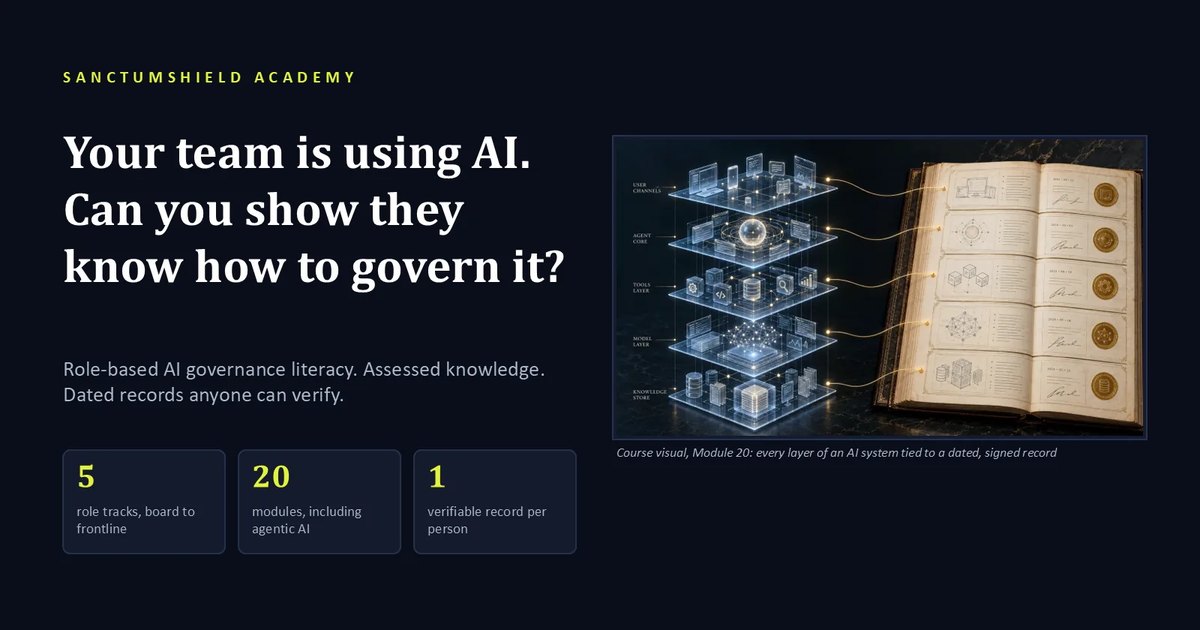
This is the presentation our partners use with buyers, written out for anyone who wants to read it at their own pace. Each slide is shown in order, with the point it makes.
The question
Most organizations already use AI every day, often inside ordinary software. The question a board, an insurer or a customer now asks is simple to say and harder to answer: can you show that the people using it know how to govern it?
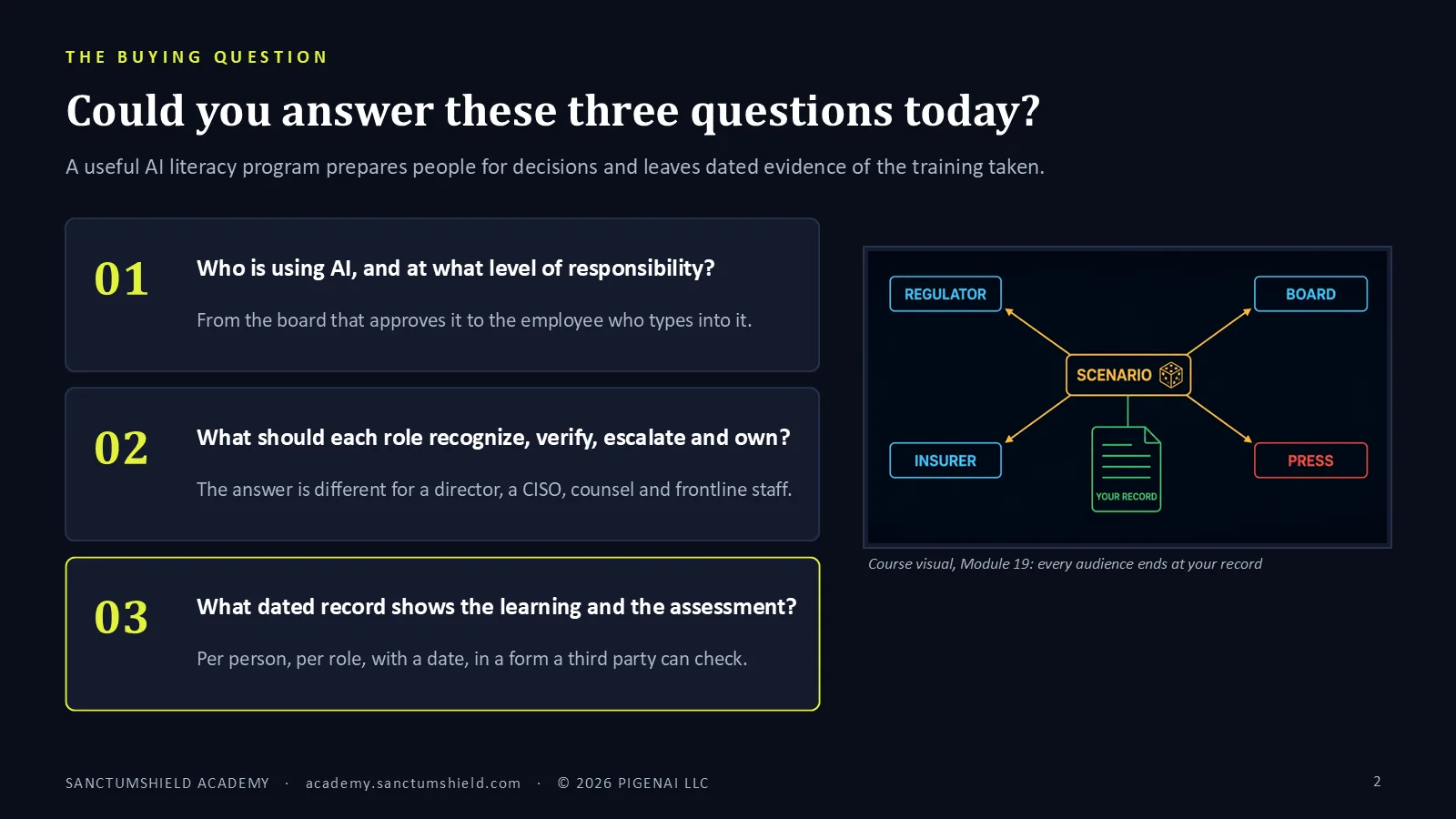
A useful AI literacy program answers three things: who is using AI and at what level of responsibility, what each role should recognize, verify, escalate and own, and what dated record shows the learning. The first two are planning questions. The third is the one people are asked for.
Why now
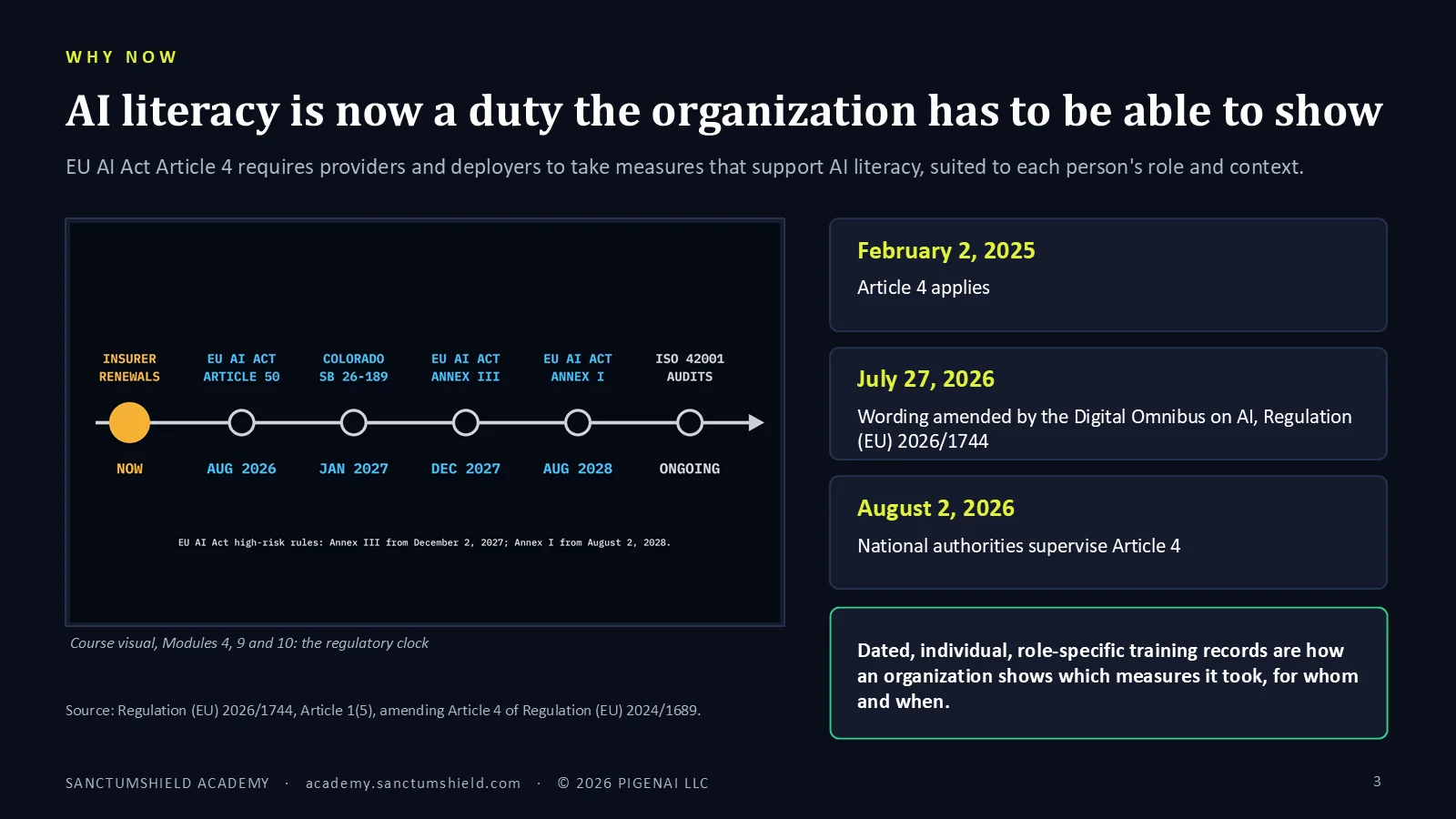
Article 4 of the EU AI Act requires measures that support AI literacy, suited to each person's role and context, and has applied since February 2, 2025. As amended by the Digital Omnibus on AI (Regulation (EU) 2026/1744, in force July 27, 2026), it requires providers and deployers to take measures to support the development of AI literacy among their staff and others operating AI systems on their behalf. National market surveillance authorities supervise Article 4 from August 2, 2026. Dated, individual, role-specific training records are how an organization shows which measures it took, for whom and when.
The evidence gap
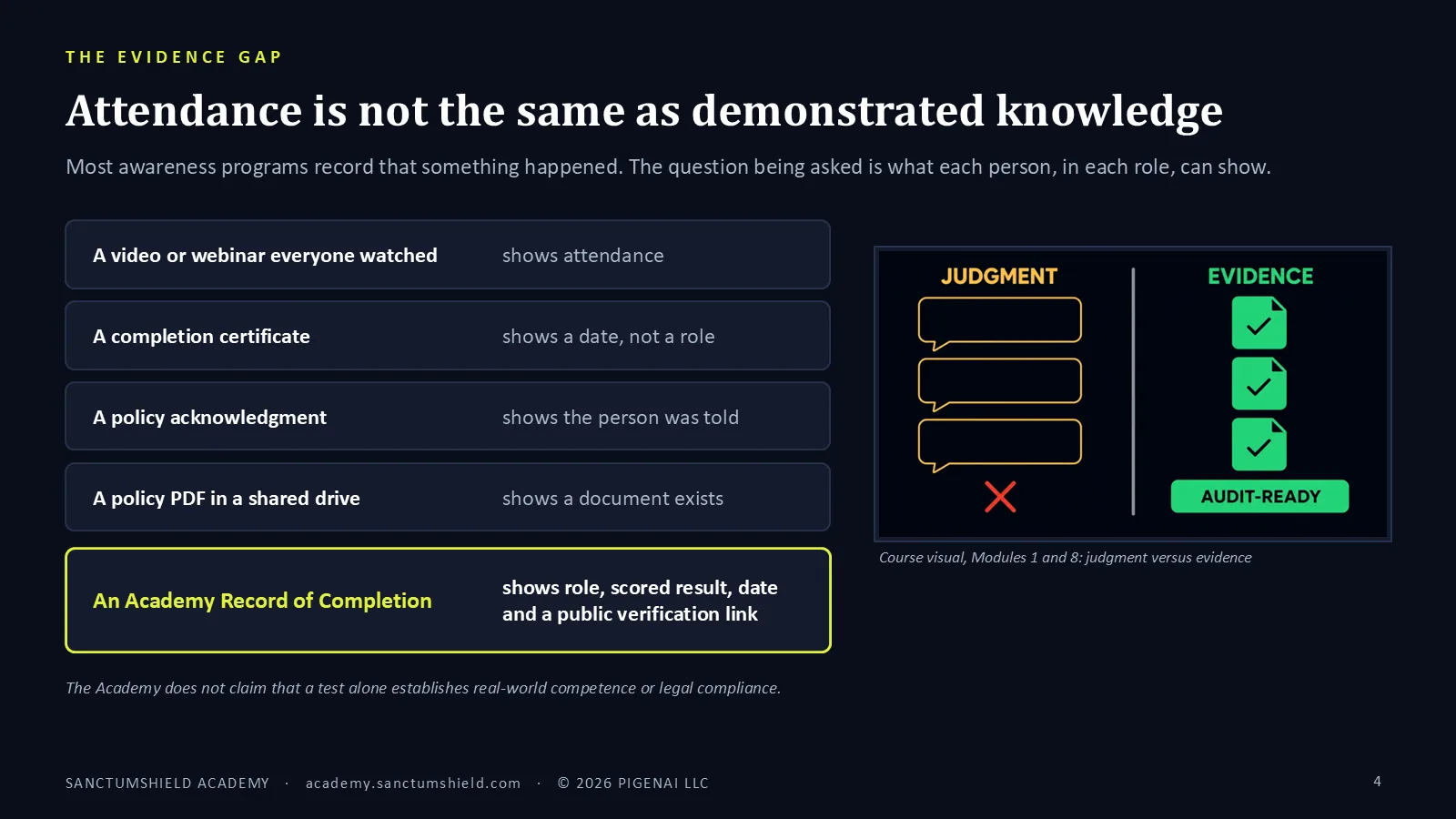
Most organizations have already done something worthwhile: a video, a completion certificate, a policy acknowledgment, a policy in a shared drive. Each records that something happened. What the question asks for is different: what each person, in each role, can show. The Academy adds that record. It does not claim that a test alone establishes real-world competence or legal compliance.
AI that acts
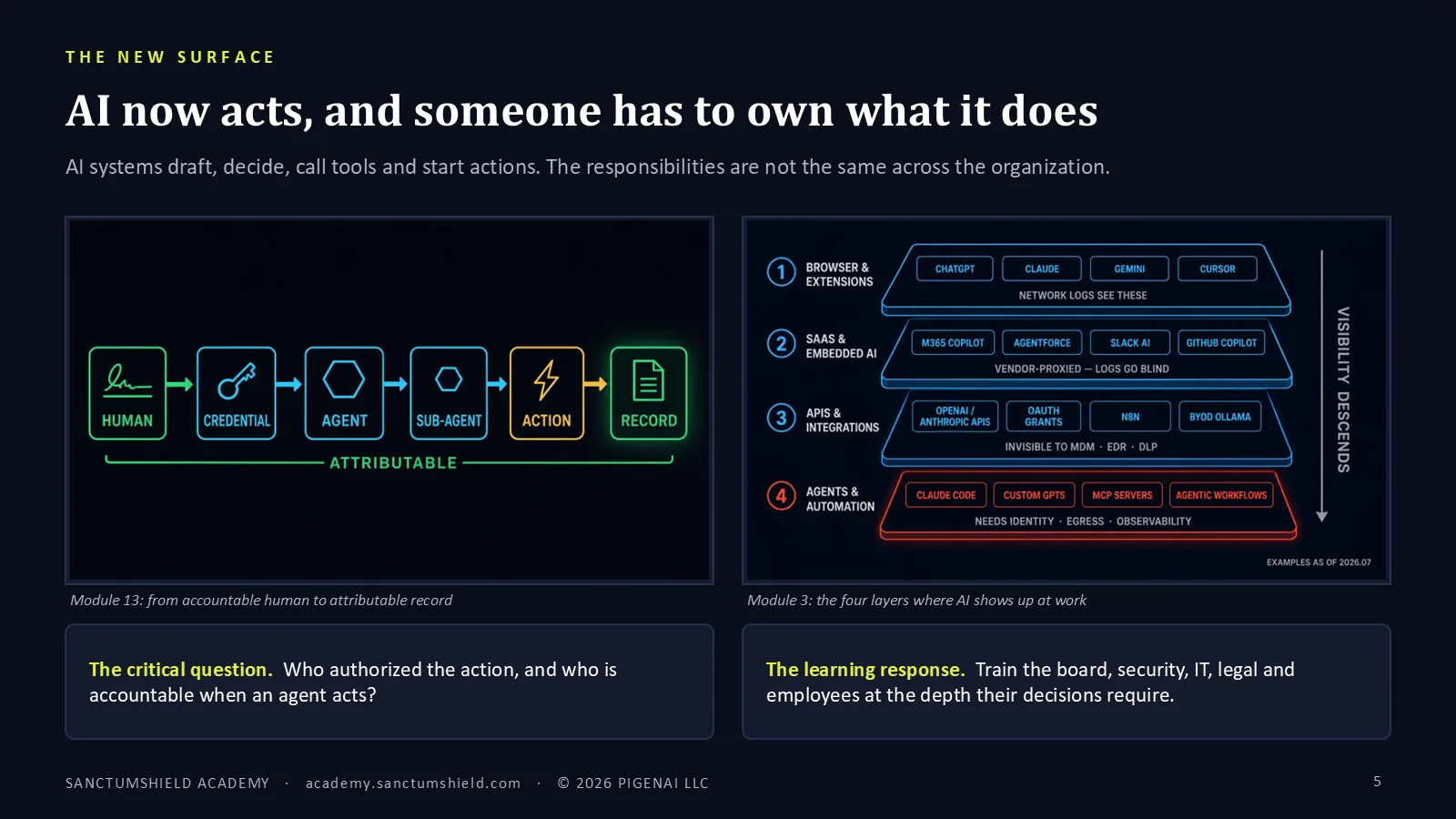
AI systems now draft, decide, call tools and start actions. That raises questions every organization needs an answer to: who authorized the action, and who is accountable when an agent acts? The board, security, IT, legal and employees each need a different depth to answer them.
Five role tracks
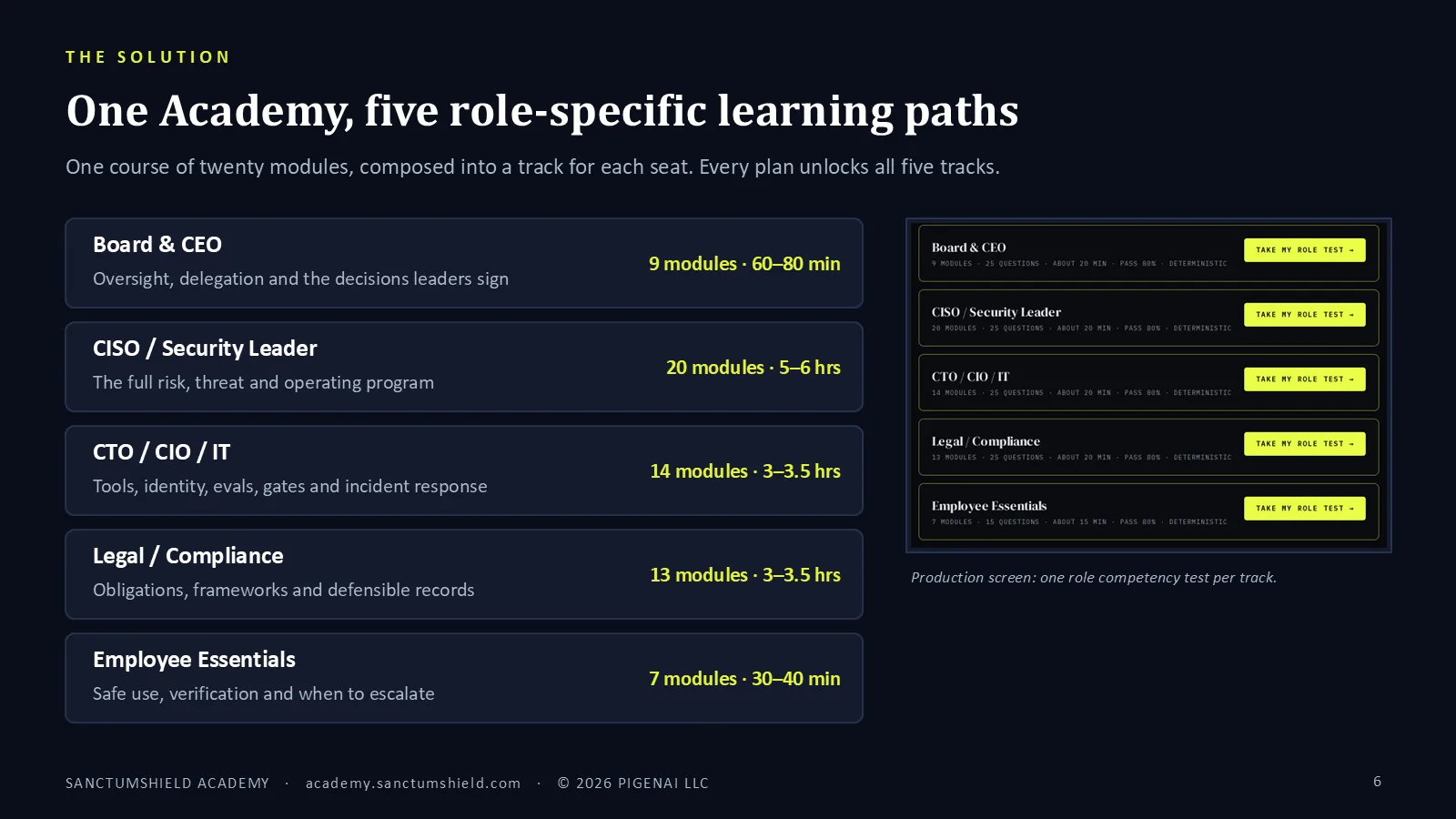
One course of 20 modules is composed into a track for each seat: Board & CEO, CISO / Security Leader, CTO / CIO / IT, Legal / Compliance, and Employee Essentials. Every plan includes all five. A director spends about an hour on oversight and what leaders sign; the CISO track covers every module.
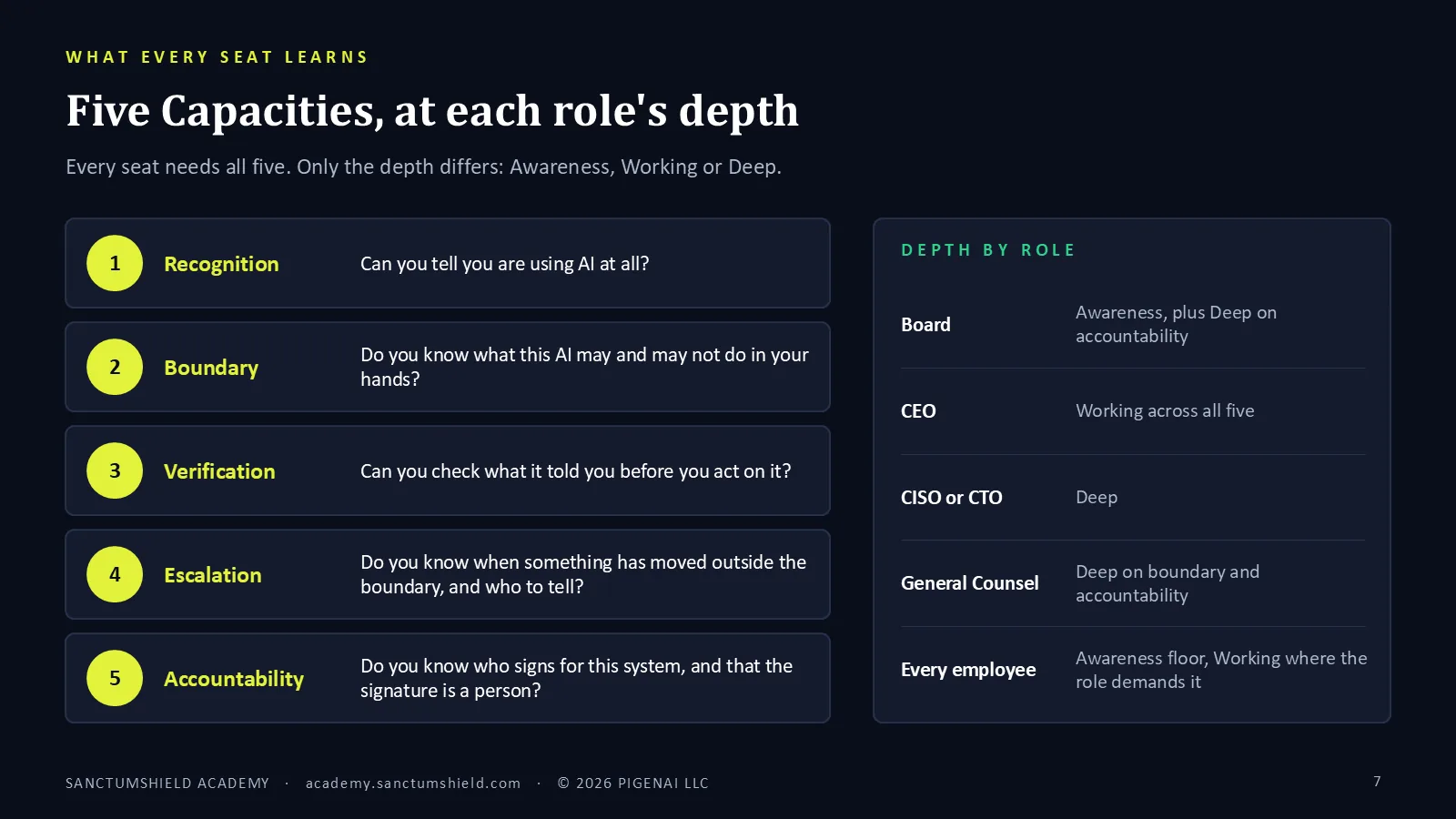
Every seat needs the same Five Capacities: Recognition, Boundary, Verification, Escalation and Accountability. What changes from role to role is the depth: awareness, working or deep.
The curriculum
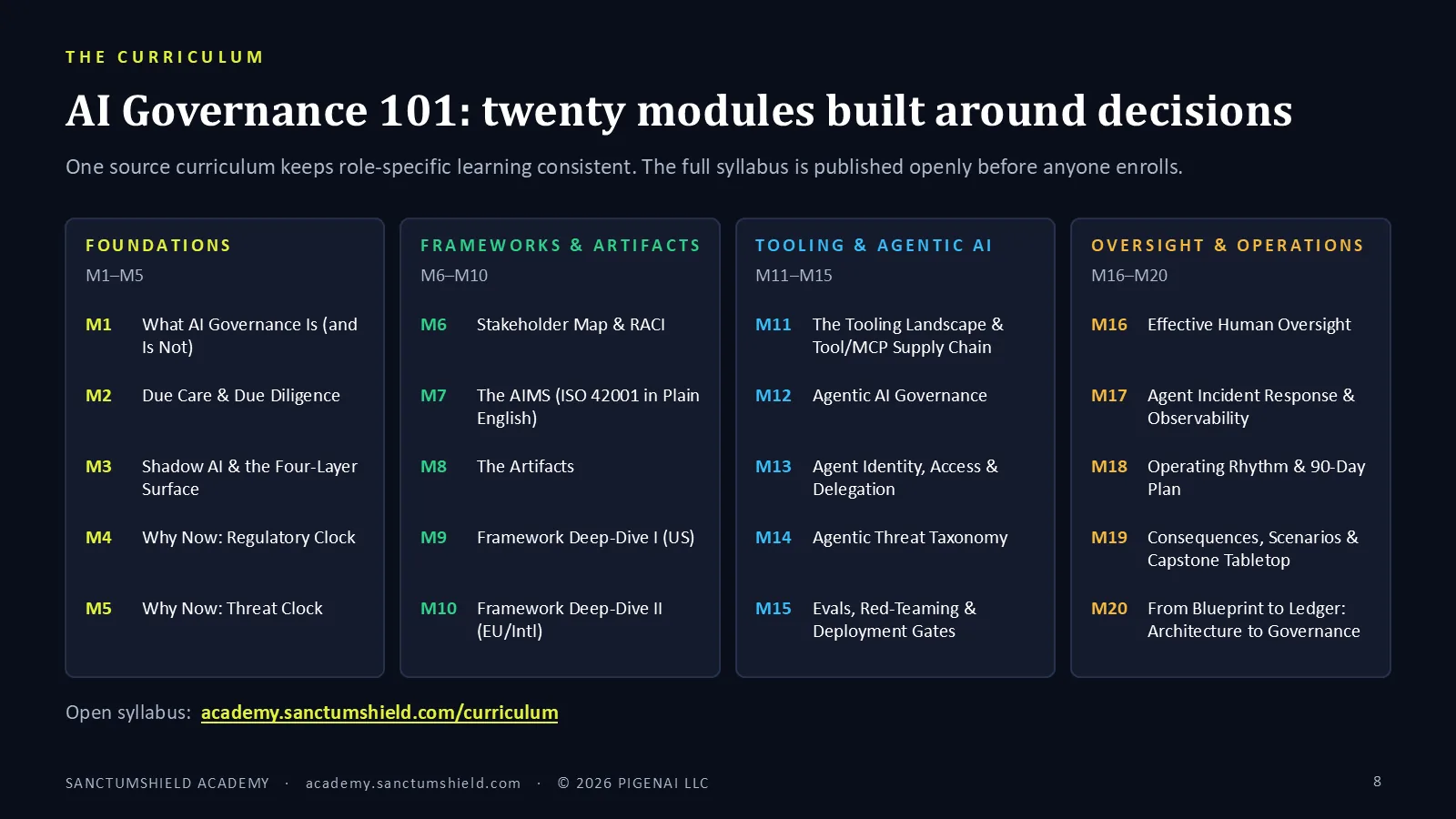
The full syllabus is published openly on the curriculum page, so a buyer can read every module title before enrolling anyone.
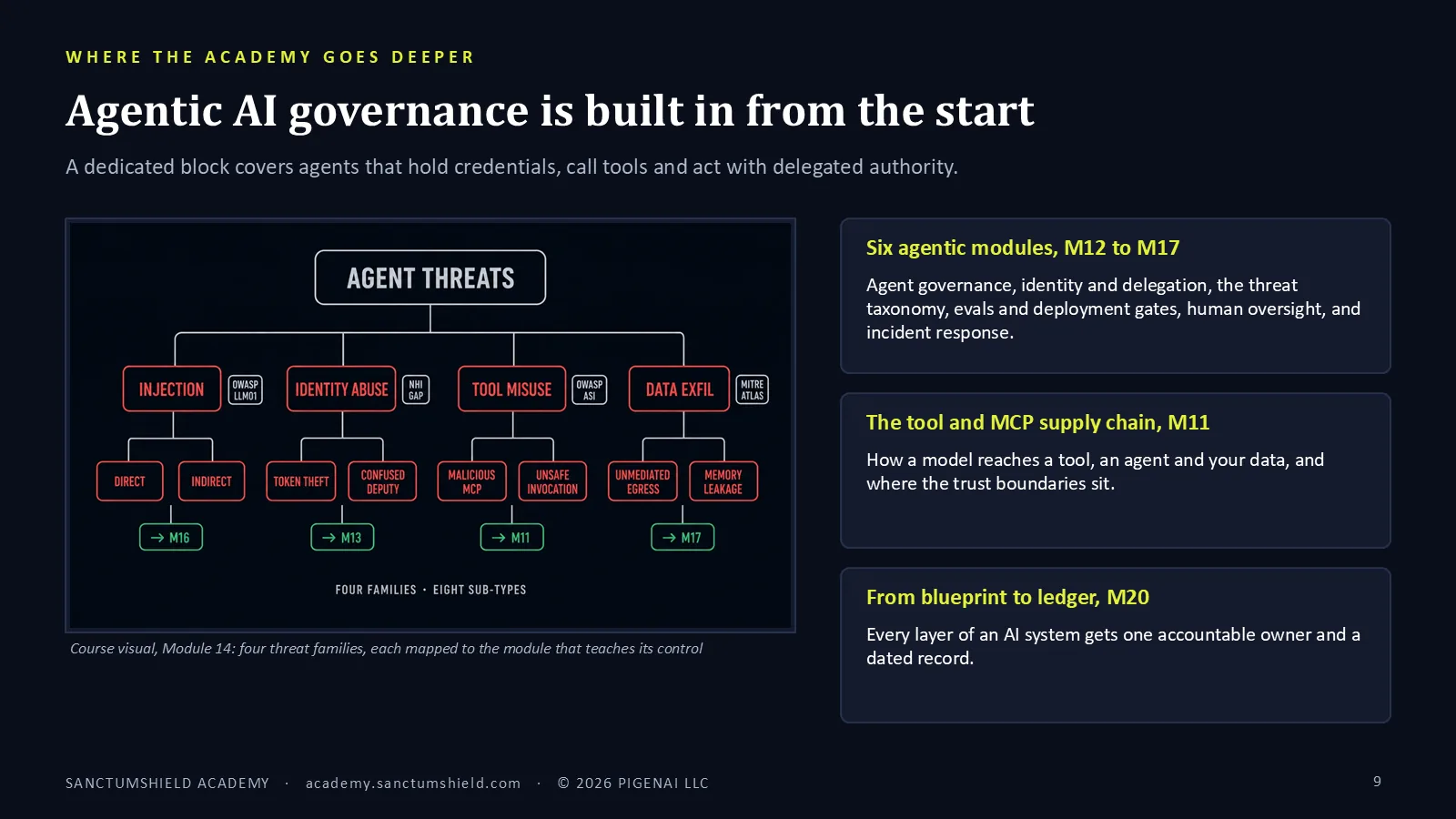
A dedicated block, modules M12 to M17, covers agents that hold credentials, call tools and act with delegated authority: governance, identity and delegation, the threat taxonomy, evals and deployment gates, human oversight, and incident response. M11 covers the tool and MCP supply chain, and M20 ties every layer of an AI system to an accountable owner and a dated record.
How people learn
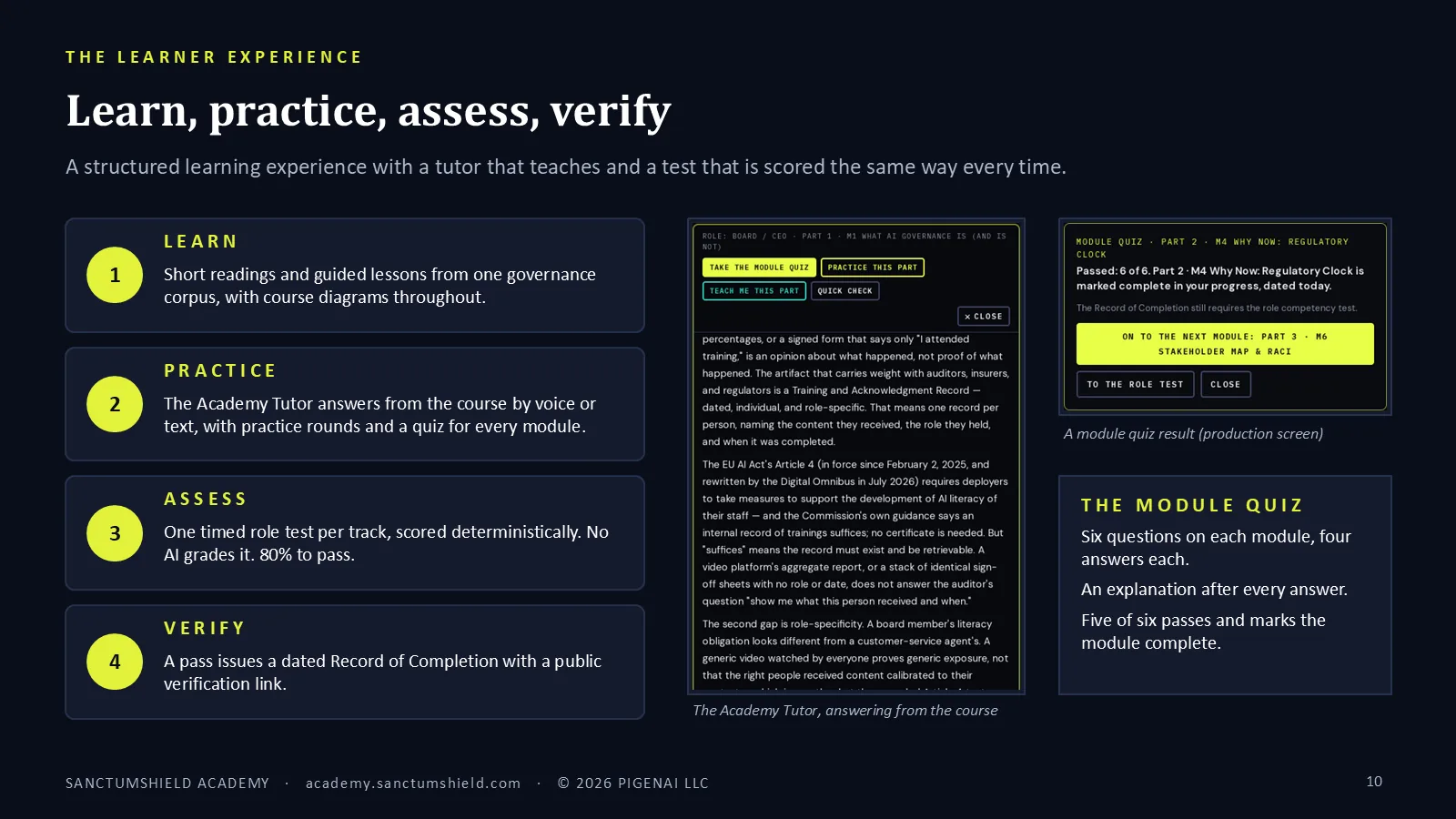
Learners read short sections and guided lessons, ask the Academy Tutor by voice or text, and practice with a quiz for every module, with an explanation after each answer. The Tutor teaches and quizzes; it never grades the role test. Each track ends in a role test scored the same way every time: no AI grades it, and 80% passes.
Proof that lasts
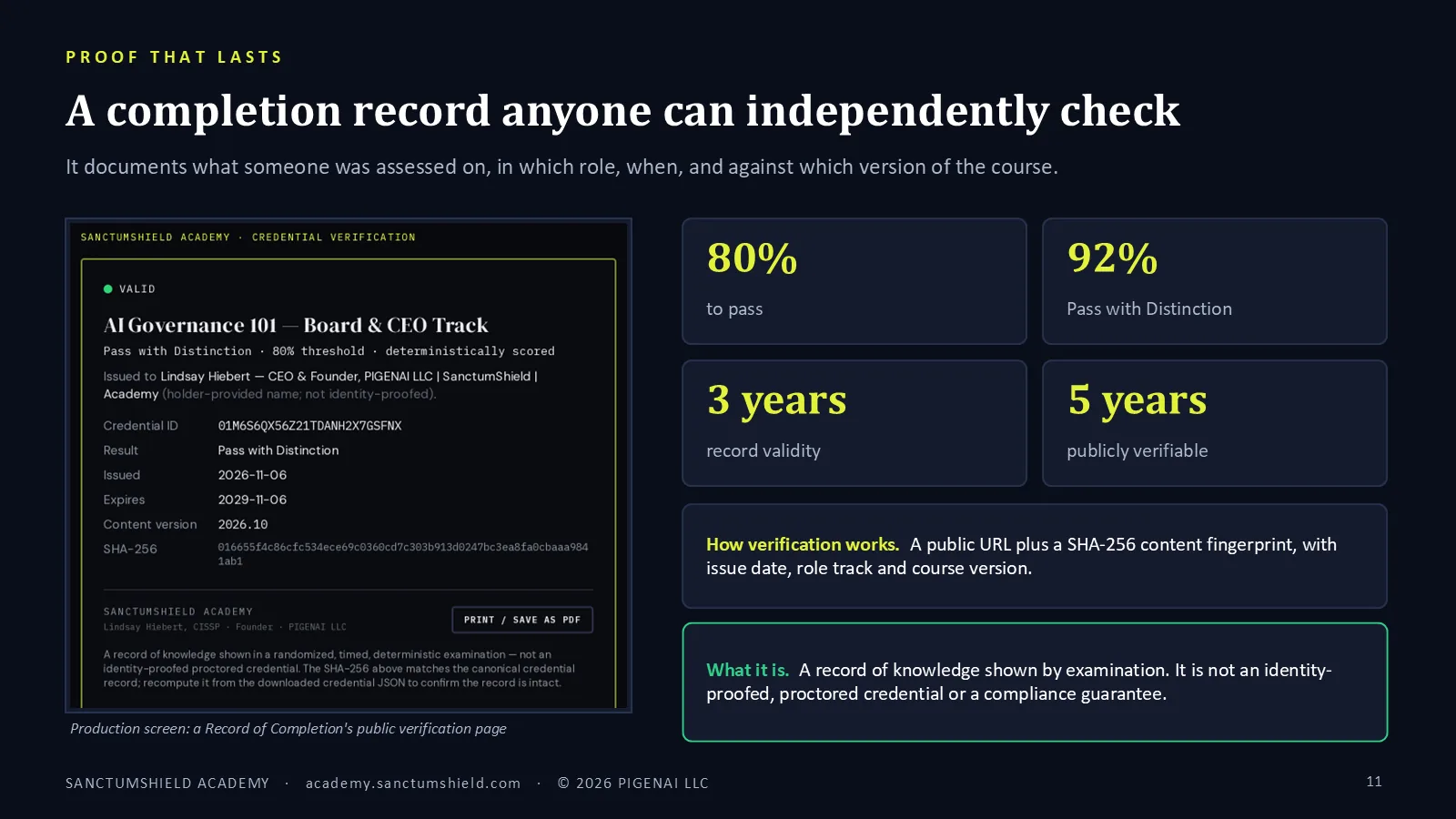
A pass issues a dated, individual, role-specific Record of Completion with a public verification link and a SHA-256 content fingerprint. 80% passes and 92% earns Pass with Distinction. A record is valid for 3 years and stays checkable after it expires, so an auditor reviewing a past period can still confirm it. It is a record of knowledge shown by examination: not an identity-proofed, proctored credential, and not a compliance guarantee.
What changes for the buyer
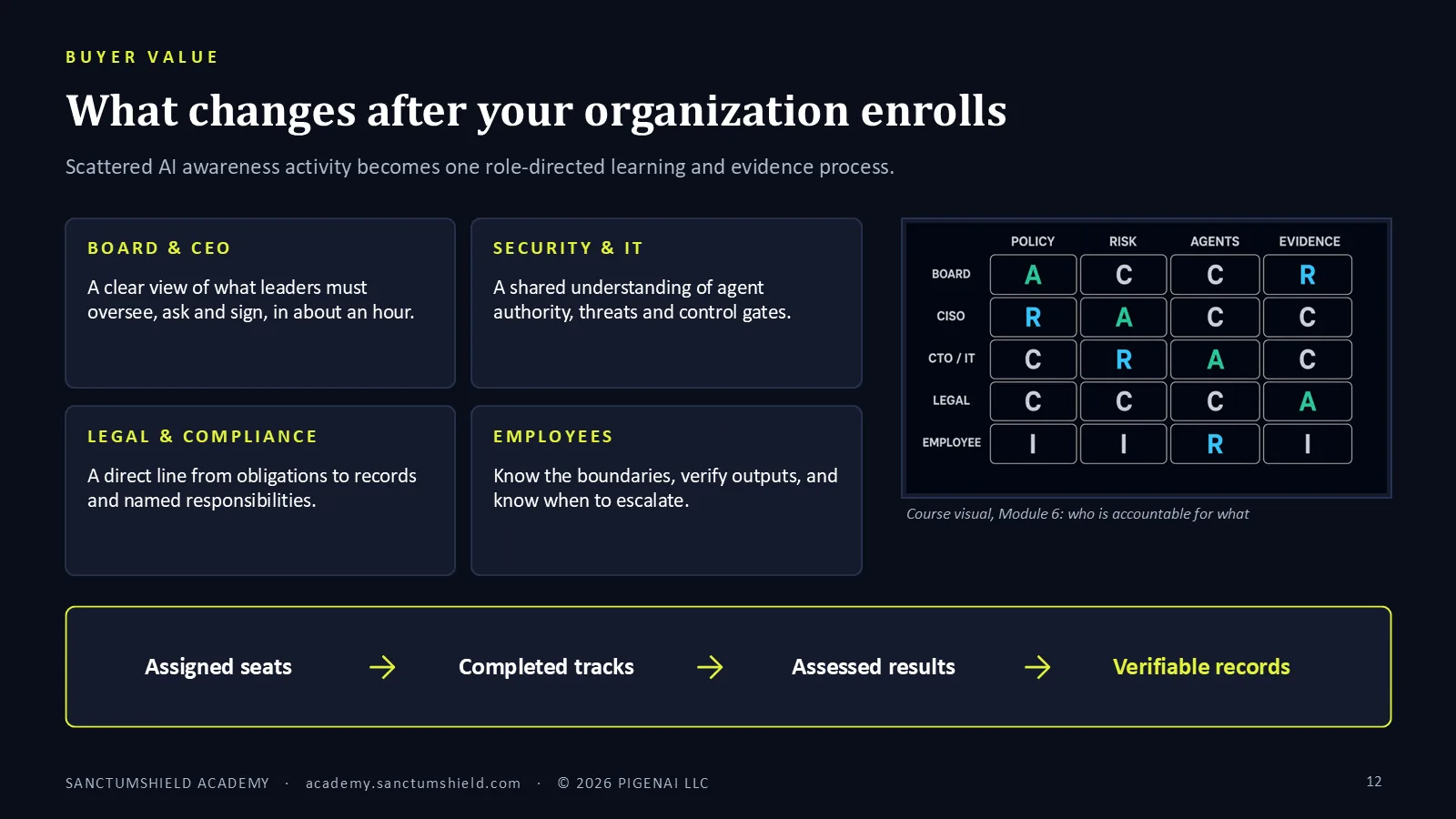
Scattered awareness activity becomes a single role-directed process that a program owner can manage: assigned seats, completed tracks, assessed results, verifiable records. On Team plans the owner sees each member's role test, result and date with a link to the record. It runs in the browser, with nothing to install or integrate.
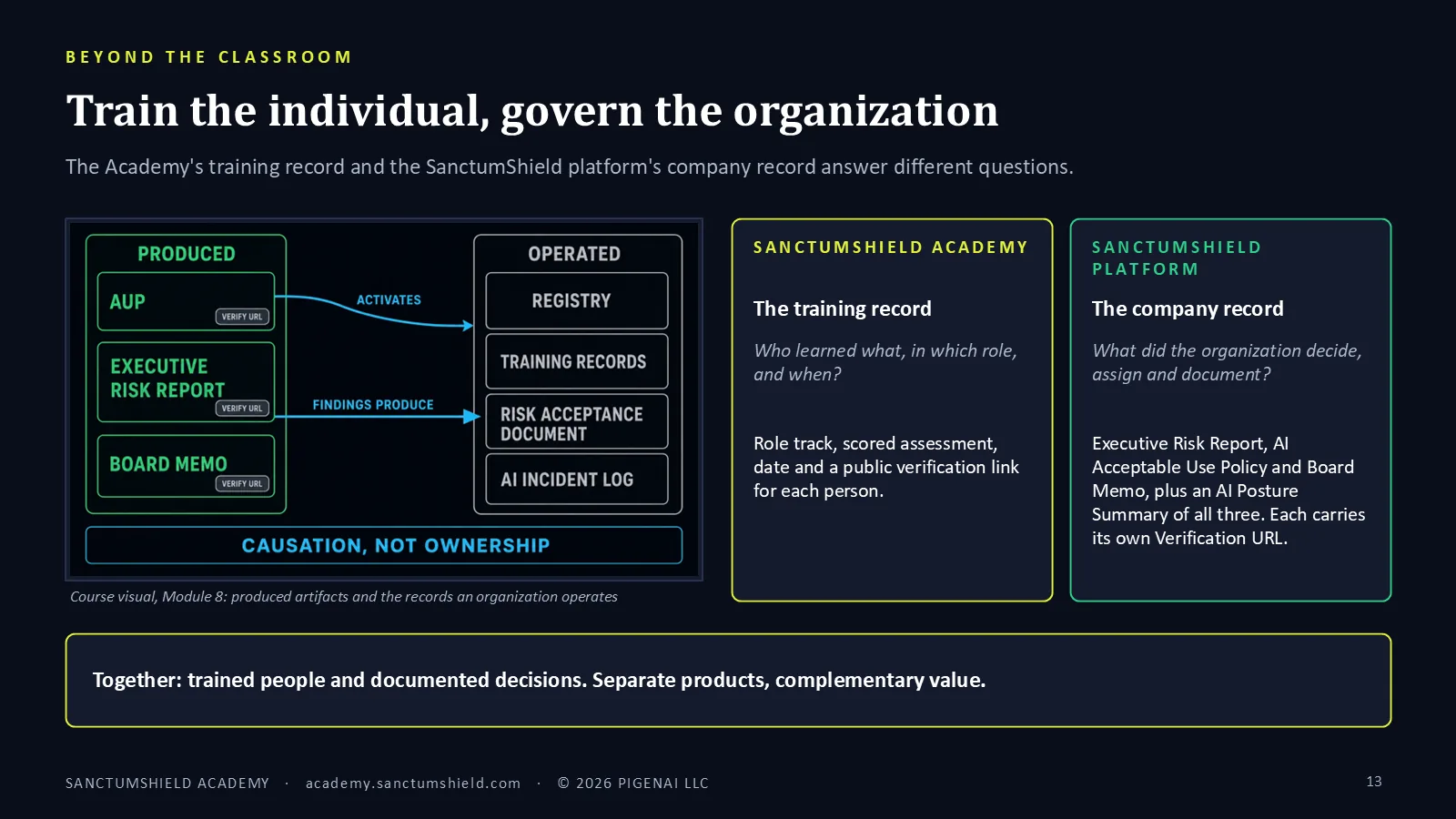
The Academy answers who learned what, in which role, and when. The SanctumShield platform answers what the organization decided, assigned and documented: the Executive Risk Report, the AI Acceptable Use Policy and the Board Memo, plus an AI Posture Summary of all three, each with its own Verification URL. They are separate products with complementary value.
Plans
Every plan includes the complete curriculum: all five tracks, all 20 modules, the Academy Tutor, the reading, the module quizzes and the role tests. Plans differ by how many learners they cover and how much Tutor time each learner has.
| Plan | Learners | Academy Tutor | A good fit for |
|---|---|---|---|
| Individual | One learner | 1,000 messages a month | One leader evaluating the course |
| Pro | One learner | 2,500 messages a month | A lead who wants more Tutor time |
| Team | Up to 10 seats | 600 messages per seat a month | A first group across all five roles |
| Team Pro | Up to 10 seats | 1,500 messages per seat a month | Team, with more Tutor time for every seat |
Reading, quizzes and role tests do not use the Tutor allowance. Plans are month to month: cancel anytime and keep every record earned. On Team plans, the owner assigns seats by email, sees every result, and can reassign a seat at any time while earned records stay valid. Current prices are on the plans page.
Getting started
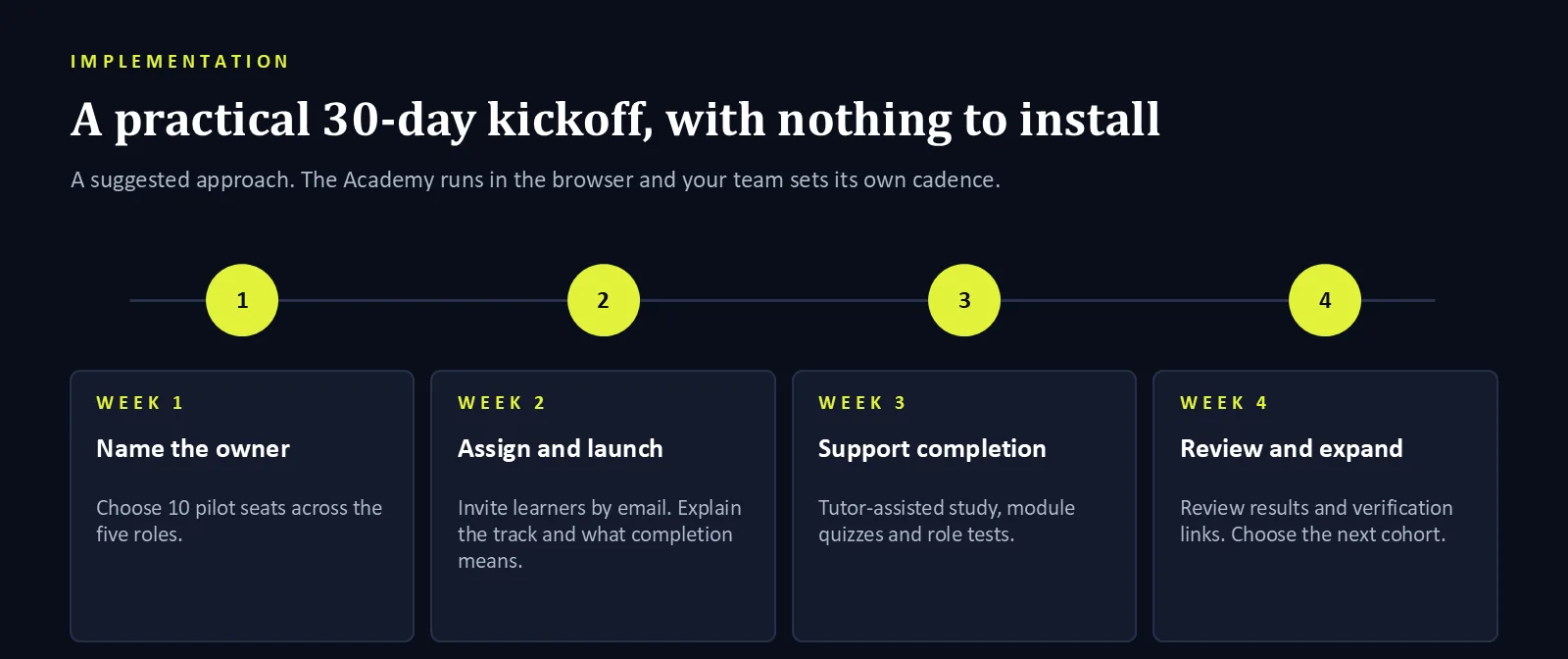
A suggested first month: in week one, name a program owner and choose the seats across the five roles; in week two, invite learners by email; in week three, support study with the Tutor, module quizzes and role tests; in week four, review the results and verification links and choose who goes next. Your team sets its own pace.
Download the brochure (PDF, two pages) to share with your team.
Buyers usually ask three things before they start.
"We already have annual training." Keep it. The Academy adds role-specific governance depth, a scored assessment and a completion record that others can check.
"Does this make us compliant?" No single course does. The Academy supports your AI literacy measures and documents them. Your organization remains responsible for its program.
"Will this take months?" No. Employee Essentials and the Board & CEO track are short; technical and legal roles go deeper, at their own pace.
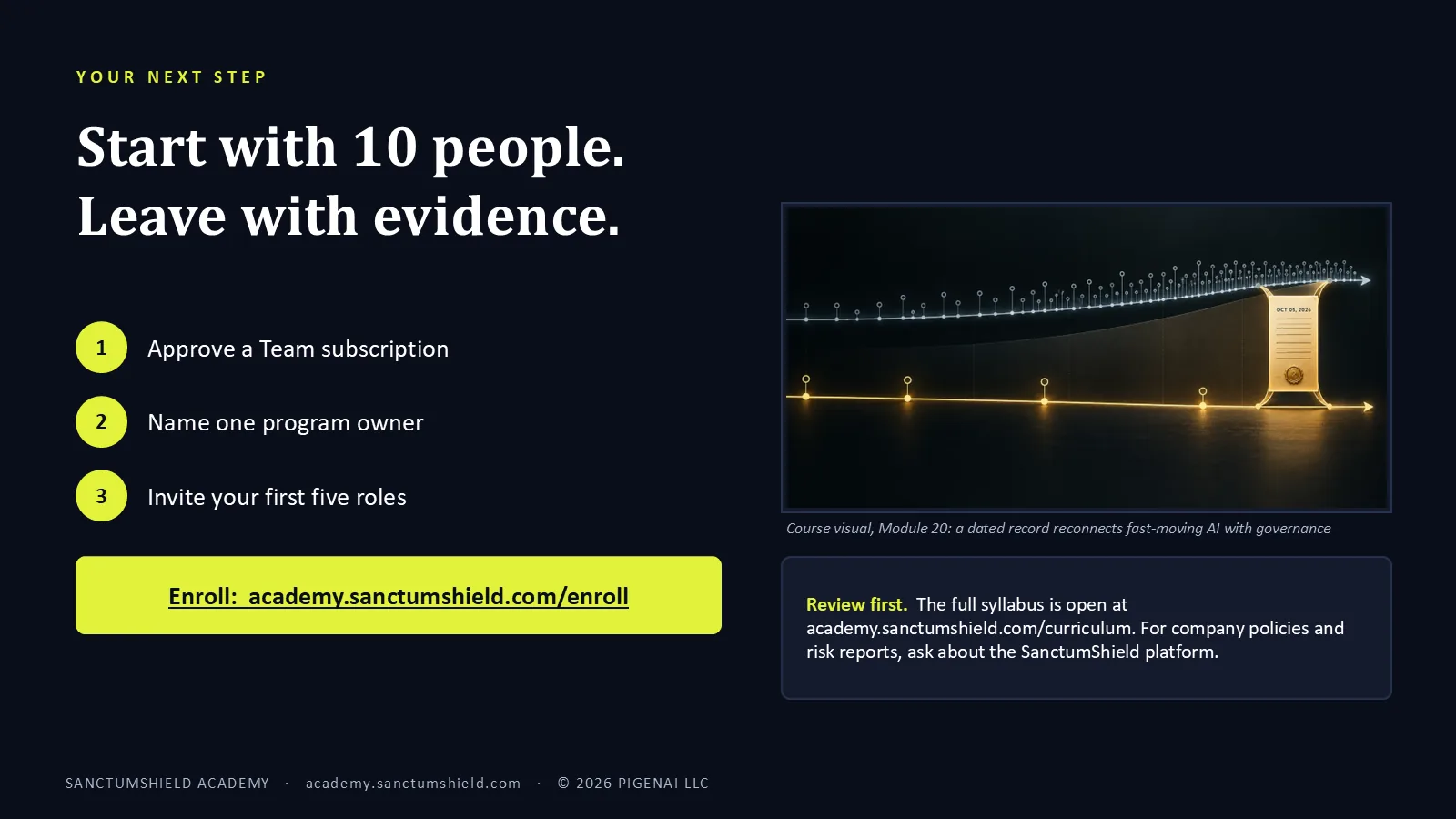
Read the full syllabus on the curriculum page, then see the plans on the enroll page. For company policies and risk reports, ask about the SanctumShield platform.